Soldier Against the World Soldier Against the World Art
John Nash (1893-1977)
Dispatches from the Trenches
The famous English artist and painter of the Slap-up War, Paul Nash, had a brother named John Northcote Nash (1893-1977), who was also an artist. Although Nash the younger was besides an official artist of the Cracking War, he was profoundly overshadowed by his more than famous blood brother, who was office of the famous Slade Schoolhouse of Art group that produced an entire generation of British artists from i grouping of students. John Nash did not attend art school, and, while he joined exhibitions of avant-garde artists in the transitional society, the Camden Town Group, he seemed to take had petty interest in the cut edge of modern art. Only his most famous painting, Over the Acme: 1st Artists' Rifles at Marcoing, 30th December 1917, is worth discussing at some length, because it captures a moment in time, the brief few seconds before the men depicted were mowed down by machine gun burn down. The fact that the soldiers marching stoically towards their fate were artists adds a level of poignancy to the painting, underlining the extent to which the all-time and the brightest, the blossom of English language youth, never left the battlefields and never lived out the lives for which they had been trained. Just they had besides been conditioned to dice.
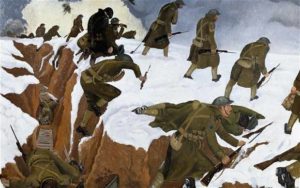
John Nash.Over the Acme: 1st Artists' Rifles at Marcoing, 30th December 1917(1918)
In an article written in 2014, commemorating the centenary of the Great State of war, John Lewis-Stempel explained why so many of the well-educated did in this conflict. The discussion had no intention of implying that privileged people should not fight for their country but to underscore how this generation was trained to go to war. As Lewis-Stempel wrote,
..as a Darwinian survival machinery the public schools of Uk were unsurpassed. They trained a whole generation of boys to be waiting in the wings of history as military machine leaders. The immature gentlemen from Eton and the Edwardian public schools paid a terrible price for this duty. It was a funny old world war, the First Globe War, but at that place was one unassailable, and surprising, truth about it. The more sectional your pedagogy, the more likely you were to die. Equally a rule of pollex twenty per cent of public school boys who fought in the war died, against 13 per cent of those overall who served. In that location are i,157 names on Eton'due south memorial to its Great War expressionless, and so many chiselled on the wall in the cloisters that it hurts the head to browse them. Historians accept a horrible phrase for this deviation between the war's full general bloodshed charge per unit and the public school charge per unit: "surplus deaths."
In other words, the per centum of deaths amongst the elite was much higher than those of the middle or lower classes. In examining Over the Superlative closely, i detail stands out–the men are not holding their weapons as if they intend to fire them. The guns hang limply as if recognizing the futility of firing. The posture of the bodies, the stooped shoulders, the walking gait, all speak of resignation, not a spirited accuse. Lewis-Steeple said,
By the rule of the British Army, junior officers were the offset "over the top" and the last to retreat..Of course, public schoolhouse boys were easier for the Germans and Turks to hitting. Due to their better diet and full general physical fitness they were, on average, five inches taller than their working-class contemporaries in 1914..One might almost say that public school boys had been physically built upwards for the slaughter. Schoolhouse sport, every bit the Duke of Wellington suggested, was a key part in their preparation as incipient warriors..Lionel Sotheby wrote in his last letter before he was killed in boxing in 1915: "Eton will be to the final the same as my parents and dear friends are to me… To die for one's school is an honour."Loyalty is an elastic concept. If a boy could be made loyal to his "house," his school, he could be fabricated loyal to his country.
To illustrate the signal made by Lewis-Stemple, which could be read as those who were trained to lead naturally stepped upwardly when the time came, the unit that Nash depicted was none other than the famous Artists' Rifles. Today the Artists' Rifles Clan still exists, describing the historic function of this very special group of artists:The 38th Middlesex Burglarize Volunteer Corps was formed on 25 May 1860 as part of the volunteer movement which arose afterwards the Crimean War. The 38th was composed of painters, sculptors, musicians, architects, actors and members of other artistic occupations and was based in the Chelsea expanse of Middlesex. For that reason information technology was almost certainly informally titled the "Artists' Volunteers." The bluecoat of the 38th Middlesex Rifle Volunteer Corps was designed by West.C. Wyon, an original member of the unit of measurement and a Queen's Medallist and Engraver to the Signet. The helmet plate badge had a "Mars and Minerva" pattern in the centre and had the characteristic Maltese Cross background associated with the rifle regiments. The Artists' Rifles adopted the 'Mars and Minerva' motif as their badge.
During the Great State of war, many artists simply went into exile, merely in England, they stood their ground and fought for their country. The number of artists who demanded to bring together this unique regiment was so dandy that the Artists' Rifles had to be divided into the 1/28th, the two/28th and the 3/28th London Regiment. And, as the website continued,During WWI, 10,256 officers were commissioned later on training with the Artists' Rifles. They went to the Pes Guards, every infantry regiment and to many of the Corps. The Royal Artillery lone had 953 officers and the London Regiment 738 officers commissioned from the Artists' Rifles. Nash served in the 1st Artists' Rifles for ii years, from 1916 to 1918, the years in which the Germans dedicated themselves to bleeding the British and the French to death. The Boxing of Cambrai was notable considering 1917 was the first fourth dimension the British used tanks in battle in an effort to break the stalemate of the lines of trenches alone the Hindenburg line. At first the surprise attack on November 20, 1917 worked and the British moved forrard. It would have some fourth dimension for the Allied forces to acquire how to effectively implement tanks equally an assault force, merely in these early months the large lumbering machines were easy targets for German artillery. Past the battle's terminate on December fourth, the initial success had become a total failure and a complete disaster for the retreating British. During this battle, at which Nash portrayed a futile attempt to advance agains the reformed High german lines, the losses were unsupportable: 44,000 killed, wounded and lost in action. As John Nash later recalled,"It was in fact pure murder and I was lucky to escape untouched."
The painting is noteworthy because despite the active participation of English artists in the Great War, it is rare for them to show actual boxing. Nash who was trained from babyhood to draw and paint the natural world, depicted the trench, non as a neatly engineered line simply as a gash in the wounded globe, zig-zagging raggedly, gouging the winter landscape. But, because his worried blood brother, Paul, managed to remove John from active combat, the painting was done from memory in the family dwelling in Buckinghamshire. Despite the fact that Over the Peak was destined for the British War Memorials Committee, it is a critique of the lack of strategic thinking on the part of the High Command, whose simply reply to the mechanized war was to throw more than and more men at the machines. As Nash said,"I call back the vivid memory of the occasion helped me when I painted the picture and provoked whatsoever intensity of feeling may be plant in it." Nash, similar the soldiers who were going over the pinnacle with him were post-obit orders, orders that would surely result in their deaths. And notwithstanding, trained in cocky-cede, they walked into death, every bit Nash expressed it they were "murdered." And for the nearly part, it was non the Germans who were blamed for the "murder," information technology was the British commanders.
As the younger brother, now safely in the company of his protective older brother, painted, he healed himself by returning to his first love, nature. As Over the Top illustrated, John Nash felt the assault of the War upon the earth very keenly. Cambrai was located in the farmlands of French republic and the Memorial, the Louverval, located in Doignies, and is surrounded past verdant countryside. Today the flat terrain is studded by wind farms, but extant photographs of northern France bear witness the terrible toll taken on the trees, which were beginning chopped down to get flooring or "duckboard" for the trenches and were and so destroyed by shelling. For Nash a botanist, the destruction of the trees, of nature was a metaphor for the devastating human loss that turned this part of French republic into a permanent cemetery. Over the Top shows a routine maneuver, a forwards advance of some fourscore men only does non reveal the equally routine retreat back to the front lines–sixty eight men did not return–John Nash was amidst the twelve survivors. No wonder his brother moved heaven and earth to extricate his young sibling from what would have been almost sure death.
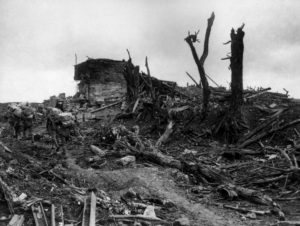
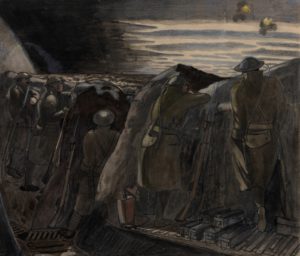
The 7th Brigade fatigue party of the Australian 2nd Division passing the "Gibraltar" bunker, Pozières, August 1916
The same ravaged fate of the copse is carefully delineated by Nash in his 1918 painting Oppy Wood, 1917, Evening, a rather ironic name, considered the splintered and torn copse that loom sadly as expressionless wood hovering over the trenches. The duckboard which lined the walkways of the trenches is all that is left of the sacrifices of the fractured trunks, now shorn of branches.
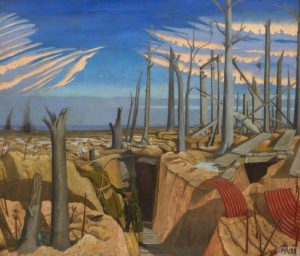
In his 2009 bookWildwood: A Journey Through Trees,Roger Deakin described Nash'south painting virtually as a story of a progressive wiping out of all nature by the merciless demands of a mechanized war. "The trenches consumed vast quantities of wood, since they had to be floored and connected with miles of duck boarding over the mud and water, and oftentimes reinforced with wooden stakes to prevent a collapse of their walls. And the stretchers, thousands of them, were of canvas between a pair of ash spars with turned handles." Deakin quoted David Jones, a Welsh poet who served on the Western Front. Jones vividly remembered the "deadened hammering of woods on forest," as the trenches were being built. Co-ordinate to the writer, Jones "often describes state of war in terms of wounded nature and the disfiguring of trees and wood," and provided the eloquent phrase from the artist, "those weeping willows shorn," which as he said referred to "the ravaging of nature, the dishonoring of the woods, comes to represent the unnatural perversity of the state of war..The flowers, copse and birds are the but vestiges of anything familiar left in the waste product land of the trenches, and they themselves expanse vulnerable as the soldiers."
According to Deakin, Nash went off to war, carrying with him a copy of George Borrow'south The Bible in Spain. Written decades after the Peninsula War, this book was published in 1843 and had trivial to practise with religion and read like an true life adventure tale of a man on a mission, to sell Castilian language Bibles to the Spanish. Traveling on horseback through a nation torn past civil war, Borrow wrote colorfully of his encounters with bandits and gypsies, angry priests and self-important academics. The tome was a strange choice for an artist and a nature lover, but the heady stories must have whiled abroad the long wearisome hour before going over the height. As Deakin wrote, Nash "painted the shattered wood on the battlefields of France. They came to stand for the dead and maimed of both sides. Some the activity took place in or around woods, which afforded cover of the troops or tanks, until they were blown to pieces. Their skeletons might be the only landmarks left on the trenched and cratered waste land. Nash writes of 'the trees torn to shreds, often reeking with poisonous substance gas.'" It is against this backdrop of retentiveness that Nash painted The Cornfield (1918), his first painting after he returned domicile safely.
John Nash.The Cornfield (1918) In his book,British Art and the Starting time Earth War, 1914–1924, James Fox described The Cornfield every bit "a conventional peace moving-picture show..Nash's film was an attempt to reconstruct the peace after the war. It was also an invaluable tool in Nash's own personal recovery from the battlefields: a 'give thanks y'all' for surviving,and a mans exorcizing his traumatic memories so he could begin his life again." For a long fourth dimension, The Cornfield and Over the Meridian stood together, side by side in the studio of the brothers. In dissimilarity to the dour scarred landscape, scathed and shorn, of Over the Meridian, The Cornfield had all the hallmarks of English landscape painting. In place of the resigned soldier trudging to their deaths, the stack of corn stand alpine and jaunty, leading the way to the pale promising fields beyond. Cupped in a protective gesture on the part of the bordering dark-green trees, the open fields, ripe with tillage, are bisected by a shaft of benign heavenly calorie-free, blessing the compensation. The brilliant golden low-cal glows in a potent and uplifting contrast to "Stand up to" Before Dawn (1918) a painting utterly without calorie-free of any kind, devoid of promise. Even the streaks of the rising sun seem feeble and malformed. John Nash.'Stand To' Before Dawn (1918) During the Dandy War, "Stand up to" referred to the twice daily order for soldiers to mount the burn down step, equally seen in the painting, ready for an assault. Since most attacks took place at dawn, presumably disturbing the end of the long nighttime, or at the end of an exhausting twenty-four hours, at twilight, the social club, referred to as "the morning hate," brought the soldiers to a condition of waiting attention for a one-half hour or even for an hour. Rifles were loaded and gear up, bayonets were fixed, fix to repel whatever invasion, as the troops Stand to Artillery, a daily ritual that began and ended every mean solar day with fear. These were the conditions in which the failed attack on Oppy Wood happened. The British attacked in the darkness before dawn, effectually iv, and were silhouetted against the still shining moon. The boxing which claimed so many lives was a feint ordered to disguise the main assault which would exist elsewhere. To those who died in yet another futile attempt to break through German lines there are no graves, no graveyard, The village of Oppy itself is tiny, without hospitable accommodations of the traveler. The men who died in that location are mentioned in the memorial of Arras, the main objective. Sadly, John Nash lived long enough to echo his operation as an Official State of war Artist, during the 2nd Earth War, the last endeavour of the Germans to dominate Europe. If yous have institute this material useful, please give credit to Dr. Jeanne Due south. M. Willette andFine art History Unstuffed. Thank y'all. [email protected] 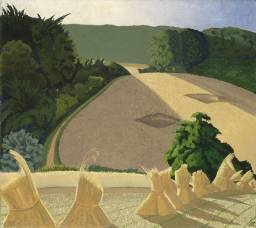
Source: https://arthistoryunstuffed.com/john-nash-the-soldiers-war/
0 Response to "Soldier Against the World Soldier Against the World Art"
Enregistrer un commentaire